
When Students Wait for the Teacher to Provide the Answer
Imagine a teacher who has recently started working in an inquiry-based learning environment.
The lesson is carefully planned. The learning objective is clear. Resources are ready, questions have been prepared, and the assessment task has been thought through.
The teacher explains the content. Students listen. They complete the activity and respond to the questions as expected.
Near the end of the lesson, the teacher asks:
“Does anyone have any questions?”
Silence.
Then, eventually, one student raises a hand:
“Will this be in the assessment?”
For many educators beginning their journey with inquiry-based learning in a PYP classroom, this moment will feel very familiar.
Nothing has necessarily gone wrong. The lesson may have been well organised, academically sound and productive. The students may even have completed everything that was expected of them.
Yet something is missing.
The learners are still behaving mainly as recipients of teaching rather than as active participants in building understanding.
Inquiry requires a different kind of classroom culture.
Kuhlthau, Maniotes and Caspari (2015) describe guided inquiry as a process in which learners actively engage with questions, information and ideas while receiving purposeful guidance from the teacher. Inquiry, therefore, is not about removing the teacher from the learning process. It is about designing learning so that students have increasing opportunities to wonder, investigate, connect, reason and construct meaning for themselves.
This leads to an important question:
How can we move from delivering learning to creating the conditions in which curiosity begins to drive it?
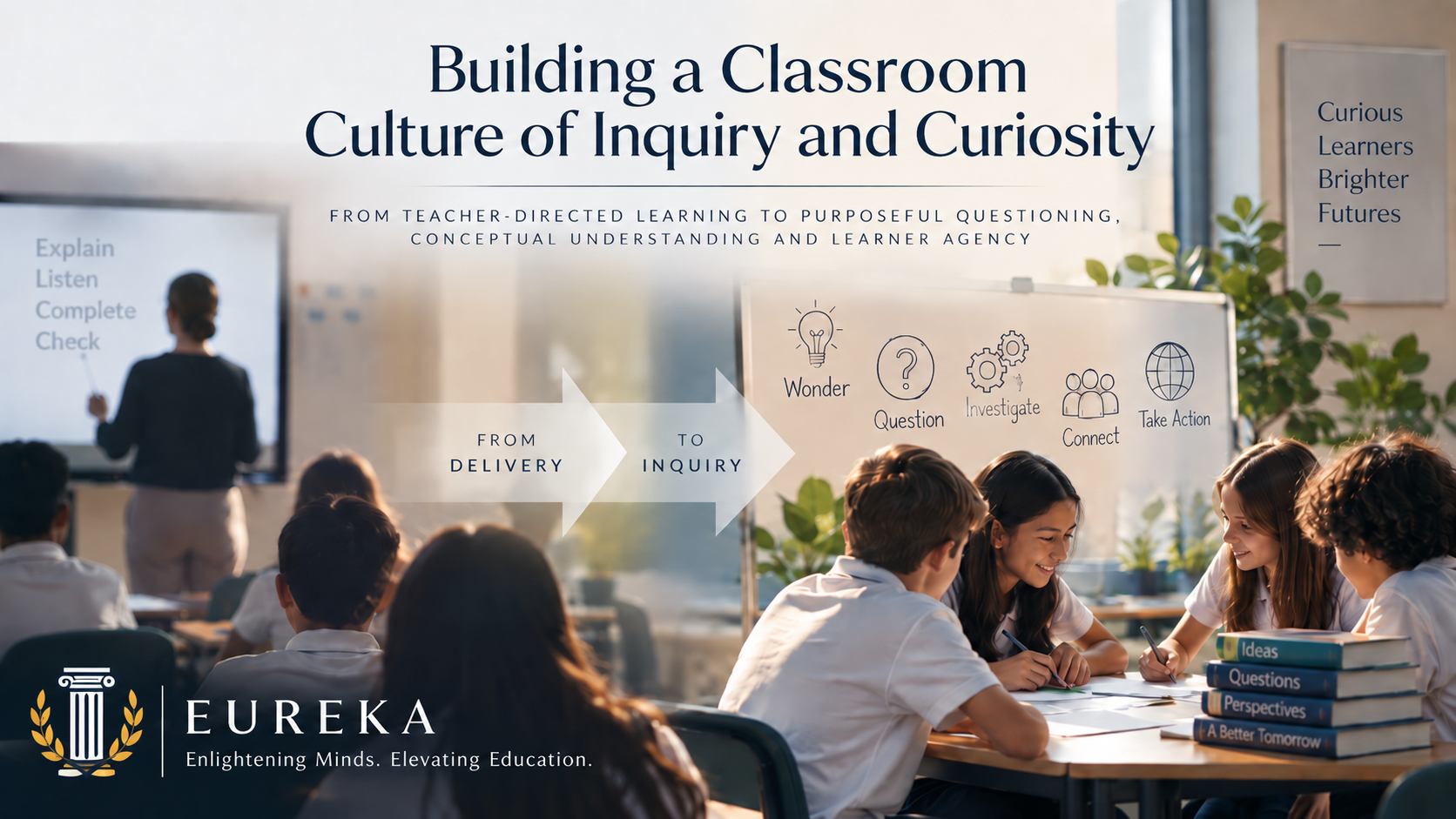
From Delivery to Inquiry
Many lessons naturally follow a familiar sequence:
Teacher explains → Students listen → Students complete → Teacher checks
There is nothing inherently wrong with this structure. In fact, there are times when clear and explicit instruction is exactly what learners need.
The problem begins when this becomes the dominant experience of learning.
Inquiry opens up a different possibility:
 The important difference is not simply the activity being used.
It is the role students are expected to play.
Instead of mainly receiving information and reproducing it, learners begin to question, interpret, test ideas, justify their thinking and connect what they are learning to other contexts.
This reflects constructivist views of learning, where understanding develops through the interaction between prior knowledge, new experiences and active meaning-making (Kuhlthau, Maniotes and Caspari, 2015).
The shift, then, is not from “teaching” to “not teaching.”
It is a shift from asking:
How will I deliver this content?
towards asking:
How will I help students engage intellectually with this content?
Begin With Something Worth Thinking About
One of the simplest ways to create curiosity is to begin with a provocation rather than an explanation.
Imagine a unit exploring access to water.
A teacher could begin by saying:
“Today we are going to learn about water scarcity.”
The students immediately know the subject. The teacher has framed the learning, introduced the vocabulary and defined the direction.
But consider another possibility.
Students enter the classroom and see three water containers.
One is full.
One is half full.
One contains only a small amount.
Beside them is a statement:
Imagine this is all the water available to your community for the next seven days.
Nothing else is explained.
Instead, students are invited to look, think and wonder.
What do you notice?
What might be happening?
What are you wondering?
Soon, questions may begin to emerge:
Who should receive the water first?
What would happen to hospitals?
Why is there not enough water?
Could water be brought in from somewhere else?
Who should decide how the water is distributed?
The content has not disappeared.
What has changed is the learners’ relationship with it.
Rather than being told what they are about to learn, students have encountered something that gives them a reason to want to know more.
Murdoch (2015) highlights the importance of uncertainty, curiosity and authentic questioning in inquiry learning. A carefully chosen provocation can activate prior understanding while creating the kind of intellectual tension that encourages learners to investigate further.
This gives teachers a useful planning question:
Not only “What do I want students to learn?” but also “What could make them want to find out?”
Resist the Urge to Explain Too Quickly
This can be one of the hardest shifts for teachers.
A student asks:
“Why do some countries experience water shortages?”
The teacher knows the answer.
It would be quick, efficient and completely reasonable to explain it.
But inquiry sometimes requires us to hold back for a moment.
Instead of answering immediately, the teacher might ask:
“What possibilities can you think of?”
Students may suggest:
-
low rainfall,
-
population growth,
-
pollution,
-
poor infrastructure,
-
climate change.
Now there is something to investigate.
The teacher can follow with:
“How could we find out which of these explanations are supported by evidence?”
This does not mean teachers should avoid explaining things.
Quite the opposite.
Expert teaching involves knowing when an explanation will move learning forward and when it might bring students’ thinking to an end too soon.
Hmelo-Silver, Duncan and Chinn (2007) argue that effective inquiry depends on appropriate scaffolding. Learners should not simply be left to discover complex knowledge by themselves.
Good inquiry sits somewhere between two extremes.
On one side is over-direction, where the teacher does almost all of the intellectual work.
On the other is under-guidance, where students are expected to navigate complex learning with very little support.
The challenge is to create productive uncertainty while still providing purposeful guidance.
Build a Classroom Where Questions Matter
Once students begin to understand that their questions genuinely matter, another challenge often appears.
They start asking lots of them.
Some questions are excellent.
Some seem unrelated.
Some could support an investigation for several weeks.
Others can be answered in ten seconds.
That is not a reason to discourage questioning.
It is an opportunity to teach students that asking good questions is itself something we learn how to do.
One simple strategy is to use a Question Parking Lot or Wonder Wall.
Student questions can be recorded and then revisited through prompts such as:
Does this question connect to our central idea?
Which concept might help us explore it?
Could this question deepen one of our current inquiries?
Does it require investigation?
Is it a question for now, later or perhaps an independent inquiry?
McTighe and Wiggins (2013) distinguish between questions that invite sustained thinking and those that mainly require factual recall. Ritchhart, Church and Morrison (2011) also show how thinking routines can make student reasoning and questioning more visible.
The aim, therefore, is not simply to generate:
more questions.
The aim is to help learners gradually develop:
better questions.
Questions that lead somewhere.
Questions that uncover relationships.
Questions that challenge assumptions.
Questions that are worth spending time thinking about.
Four Words That Can Deepen Thinking
Sometimes a small change in teacher language can completely change the quality of classroom thinking.
Imagine a student looking at an image and saying:
“Family seems important to these people.”
The teacher could respond:
“Good.”
And the conversation would probably end.
Or the teacher could ask:
“What makes you say that?”
Four simple words.
But now the learner has to go back to the evidence.
The response might become:
“They are gathered closely together and seem to be sharing something.”
Another student might respond:
“But being together doesn't necessarily prove that family is important.”
Now the discussion has moved somewhere more interesting.
Students are thinking about:
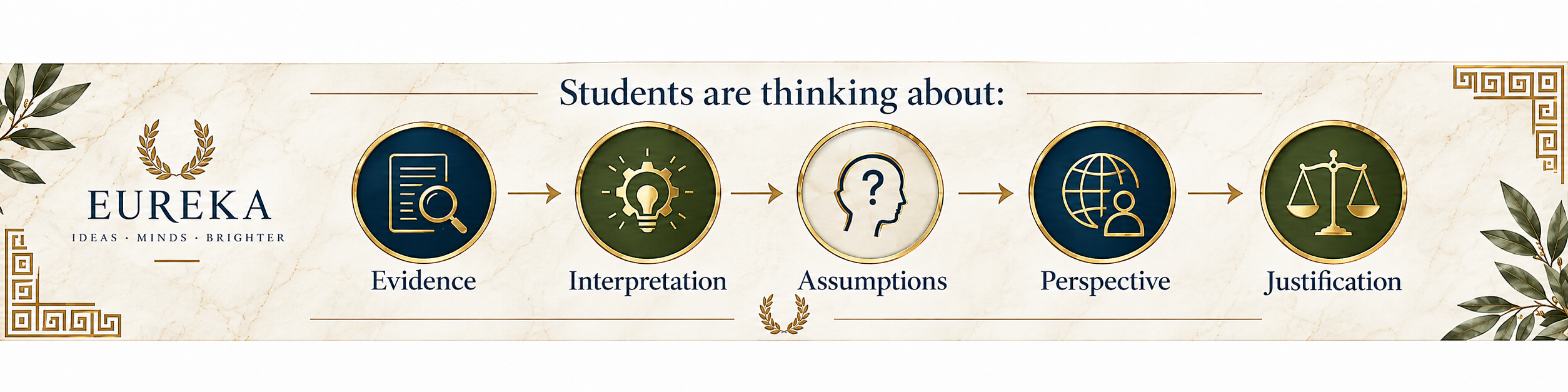 The original answer is no longer the end of the conversation. It has become the beginning of one.
This is the kind of thinking made visible through the routines described by Ritchhart, Church and Morrison (2011).
A Practical Thinking Routine
One of the most useful routines for developing this habit of mind is very simple.
SEE
What can you observe?
Students begin with what is actually visible rather than immediately jumping to conclusions.
THINK
What do you think might be happening?
Learners begin interpreting the evidence.
WONDER
What questions are emerging for you?
Students identify what they still want or need to understand.
Then comes the question that often deepens the thinking:
What makes you say that?
This final prompt asks students to connect interpretation back to evidence.
The routine itself is simple.
The thinking it can generate is not.
Move Beyond Facts Towards Conceptual Thinking
Inquiry does not mean factual knowledge is unimportant.
Students need knowledge.
Without sufficient knowledge, there is very little to think deeply about.
The issue arises when learning continually stops at factual recall.
Compare the following questions.
What is migration?
with:
Why might people leave everything familiar behind?
Or:
What is a rule?
with:
When do rules protect people, and when might they restrict them?
Or:
What is culture?
with:
How do the people and places around us influence who we become?
The second question in each pair requires something more than remembering a definition.
Students have to consider examples, relationships, perspectives and possible generalisations.
Wiggins and McTighe (2005) argue that curriculum design should move beyond simply covering content towards developing deeper and transferable understanding.
Concepts can help create that movement.
Take a familiar topic such as plastic.
Through the lens of causation, students might ask:
Why has plastic pollution become such a significant problem?
Through connection:
How are everyday consumer choices connected to environmental systems?
Through change:
How has society's relationship with plastic changed over time?
Through perspective:
Why might consumers, businesses and environmental organisations view plastic differently?
And through responsibility:
Who should be responsible for reducing plastic waste?
The topic has not changed.
The intellectual demand has.
Students are no longer simply learning about plastic.
They are exploring relationships, consequences, perspectives and responsibility.
Inquiry Still Needs Structure
One of the common mistakes in moving towards inquiry is making the shift too quickly from highly teacher-directed learning to completely open inquiry.
Students are told:
“Choose a question and investigate it.”
Twenty minutes later, one group is copying information from a website.
Another has already started designing presentation slides before really understanding the issue.
Another cannot remember what its original question was.
And another has somehow moved into a completely unrelated topic.
It is tempting to conclude:
“These students are not ready for inquiry.”
But there is another possibility.
Perhaps they need stronger scaffolding.
Hmelo-Silver, Duncan and Chinn (2007) make an important distinction between minimally guided learning and appropriately scaffolded inquiry.
Inquiry does not mean removing structure.
It means using structure in ways that support student thinking without taking intellectual ownership away from them.
A teacher might pause an investigation and ask:
What are we actually trying to understand?
What do we already think we know?
What evidence do we need?
Which sources might be useful and reliable?
What patterns are beginning to emerge?
Is there anything that challenges our current explanation?
What should we investigate next?
Students still influence the direction of the inquiry.
But the learning remains intentionally designed.
Inquiry Does Not Mean the Teacher Disappears
Another misunderstanding is that inquiry-based learning requires teachers to avoid direct instruction.
It does not.
Students may need:
-
subject knowledge,
-
academic vocabulary,
-
research strategies,
-
mathematical procedures,
-
models,
-
worked examples,
-
feedback,
-
explicit instruction.
Sweller (2004) highlights the importance of instructional support when learners are dealing with unfamiliar or cognitively demanding material. Hmelo-Silver, Duncan and Chinn (2007) similarly show that strong inquiry includes scaffolding and teacher guidance.
The more useful question is therefore not:
Should I teach directly or should I use inquiry?
Instead, ask:
What do these learners need from me at this particular point in their learning?
Sometimes the answer is:
Explain.
Sometimes:
Model.
Sometimes:
Question.
Sometimes:
Provide feedback.
And sometimes:
Step back and give them time to think.
The skill lies in knowing the difference.
From Choice to Genuine Learner Agency
Agency can sometimes be reduced to giving students choices.
Poster or presentation?
Individual or partner work?
Paper or digital?
Those choices can certainly be useful.
But agency goes further.
Bandura's work on agency and self-efficacy emphasises people's capacity to influence their actions and development (Bandura, 1997; 2001).
Imagine a student exploring food waste.
Rather than simply completing a research task assigned by the teacher, the student asks:
“Could I investigate food waste in our school?”
The teacher does not immediately say yes or no.
Instead, the teacher asks:
“How would that help you develop the understanding we are exploring?”
The student then suggests collecting data, interviewing other students and speaking with cafeteria staff.
Something important has changed.
The student is no longer simply choosing how to complete the teacher's task.
The student is beginning to influence how the inquiry itself develops.
That is a much deeper form of ownership.
When Inquiry Leads to Action
Suppose the students continue investigating food waste.
They collect evidence.
They identify patterns.
They explore possible causes.
They listen to different perspectives.
Eventually, someone asks:
“What should we do about this?”
That question matters.
The teacher could immediately assign an awareness poster.
But another possibility is to return the question to the learners.
Perhaps they decide to:
-
speak with school leadership,
-
gather more evidence,
-
explore changes to portion sizes,
-
develop an awareness initiative,
-
or even conclude that they do not yet understand the issue well enough to act responsibly.
Boix Mansilla and Jackson (2011) connect global competence with the ability to investigate significant issues, recognise perspectives and engage thoughtfully with the world.
Action, therefore, does not always have to be large or dramatic.
Sometimes action is behavioural.
Sometimes it is collaborative.
Sometimes it is reflective.
And sometimes the most responsible action is deciding that more evidence is needed before doing anything at all.
A valuable question for teachers is:
What might learners think, feel or do differently because of what they now understand?
From Curiosity to Action
Inquiry can be thought of as a journey rather than a fixed set of steps.
It may begin with a provocation:
Something attracts attention.
That creates curiosity:
I wonder...
Curiosity begins to generate questions:
Why? How? What if?
Questions lead to inquiry:
Investigate • Research • Experiment • Discuss
Through inquiry, learners begin developing conceptual understanding:
Connect • Generalise • Transfer
They then reflect:
How has my thinking changed?
Reflection can create greater agency:
What matters? What choices can I make?
And agency may lead to action:
What might I do because of what I now understand?
But inquiry rarely ends neatly there.
Very often, deeper understanding creates:
new questions.
Perhaps that is one of the strongest signs that meaningful inquiry has taken place.
Students do not simply leave with an answer.
They leave noticing that there is more worth understanding.
Start With One Change
Creating an inquiry-rich classroom does not require redesigning an entire curriculum overnight.
Sometimes the most useful starting point is one lesson.
Take an explanation you would normally give at the beginning and replace it with something that creates a reason to think:
an unusual image,
an object,
a contradiction,
a surprising statistic,
a real-world problem,
or a carefully selected artefact.
Then ask:
What do you notice?
What do you think?
What are you wondering?
When a learner responds, resist the temptation to immediately evaluate the answer.
Instead, try:
“What makes you say that?”
Then listen.
Really listen.
The quality of inquiry in a classroom is not determined by how many activities appear on the planner or how many colourful resources have been prepared.
It is reflected in the intellectual behaviours that gradually become normal:
questioning
reasoning
justifying
connecting
challenging
reflecting
reconsidering
and eventually,
acting.
These habits do not appear because the word inquiry has been written on the unit plan.
They develop through the learning experiences, conversations and expectations that students encounter every day.
Teachers Are Inquirers Too
Perhaps one of the most reassuring ideas for teachers beginning to work with inquiry is that becoming an inquiry teacher does not mean having every lesson perfectly designed.
Teachers themselves are inquirers.
We observe students.
We notice patterns.
We develop hypotheses about what might help.
We try strategies.
We gather evidence.
We reflect on what happened.
We adjust.
And then we try again.
In that sense, creating a culture of inquiry is not only about changing the way students learn.
It also asks teachers to inquire into their own practice.
A useful reflection at the end of a lesson might simply be:
Where in tomorrow's lesson would I normally provide the answer—and what might happen if I created space for students to think first?
Sometimes the shift towards inquiry begins with something surprisingly small.
Instead of:
“Here is the answer.”
perhaps:
“Interesting. What do you think?”
And then giving students enough time—and enough trust—to see what comes next.
Eureka Reflection
At Eureka, we believe meaningful professional learning happens when research, reflection and classroom practice genuinely connect.
Educational terminology has limited value if it does not change the experiences we design for learners.
Inquiry becomes meaningful when curiosity leads to questioning, questions create a reason to investigate, investigation strengthens understanding, and that understanding gives learners greater opportunity to make thoughtful choices and take meaningful action.
For educators, the challenge is not to create a classroom in which the teacher never explains.
It is to create one in which students do more of the intellectual work.
A classroom where learners increasingly ask questions, look for evidence, challenge ideas, make connections, revise their thinking and recognise that their understanding can influence what they do next.
That is where inquiry begins to move beyond a teaching approach.
It becomes part of the culture of learning.
Eureka
Enlightening Minds. Elevating Education.
References
Bandura, A. (1997) Self-efficacy: The exercise of control. New York: W.H. Freeman and Company.
Bandura, A. (2001) ‘Social cognitive theory: An agentic perspective’, Annual Review of Psychology, 52(1), pp. 1–26.
Boix Mansilla, V. and Jackson, A. (2011) Educating for global competence: Preparing our youth to engage the world. New York: Council of Chief State School Officers’ EdSteps Initiative and Asia Society Partnership for Global Learning.
Hmelo-Silver, C.E., Duncan, R.G. and Chinn, C.A. (2007) ‘Scaffolding and achievement in problem-based and inquiry learning: A response to Kirschner, Sweller, and Clark (2006)’, Educational Psychologist, 42(2), pp. 99–107.
Kuhlthau, C.C., Maniotes, L.K. and Caspari, A.K. (2015) Guided inquiry: Learning in the 21st century. 2nd edn. Santa Barbara, CA: ABC-CLIO.
McTighe, J. and Wiggins, G. (2013) Essential questions: Opening doors to student understanding. Alexandria, VA: Association for Supervision and Curriculum Development.
Murdoch, K. (2015) The power of inquiry. Melbourne: Seastar Education Consulting.
Ritchhart, R., Church, M. and Morrison, K. (2011) Making thinking visible: How to promote engagement, understanding and independence for all learners. San Francisco, CA: Jossey-Bass.
Sweller, J. (2004) ‘Instructional design consequences of an analogy between evolution by natural selection and human cognitive architecture’, Instructional Science, 32(1–2), pp. 9–31.
UNESCO (2015) Global citizenship education: Topics and learning objectives. Paris: UNESCO.
Wiggins, G. and McTighe, J. (2005) Understanding by design. 2nd edn. Alexandria, VA: Association for Supervision and Curriculum Development.